
How to Get a Loan for House Renovations: A Complete Guide for Homeowners
October 20, 2026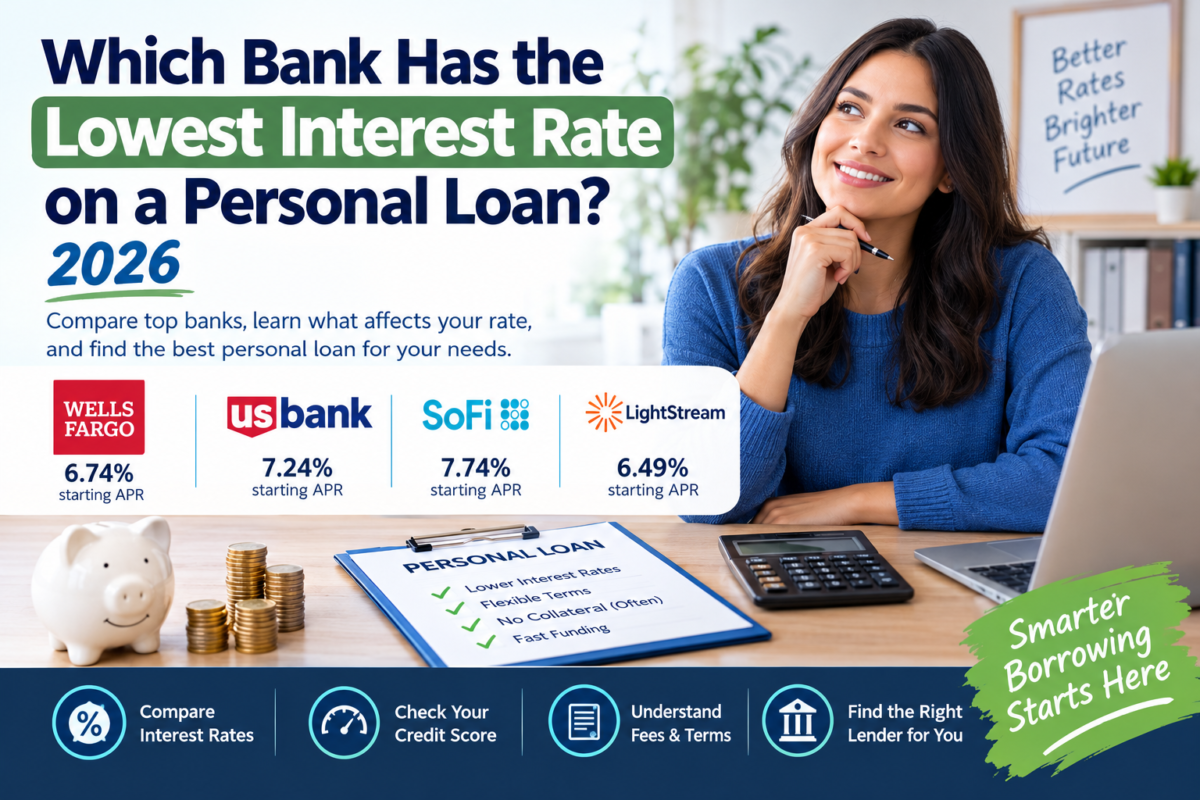
Finding a personal loan with a low interest rate can help you borrow money while keeping your monthly payments and total borrowing costs manageable. Whether you need funds for debt consolidation, home improvements, medical expenses, education costs, or an unexpected emergency, comparing lenders is one of the most important steps before applying.
The answer to “which bank has the lowest interest rate on a personal loan?” depends on several factors, including your credit score, income, existing debt, loan amount, repayment term, and the lender’s eligibility requirements. A bank advertising a very low starting rate may not offer that rate to every applicant.
This guide explains how to compare personal loan interest rates in the United States, which banks and lenders are worth considering, how to qualify for a lower rate, and how to avoid expensive borrowing mistakes.
1. Which Banks Have the Lowest Personal Loan Interest Rates?
There is no single bank that offers the lowest personal loan rate to every borrower. However, several banks advertise competitive starting APRs, especially for applicants with excellent credit.
The following comparison highlights lenders worth checking when shopping for a personal loan in the United States.
| Bank or lender | Advertised starting APR | Important consideration |
|---|---|---|
| Wells Fargo | 6.74% | The published rate includes a discount; personal loans are available to existing Wells Fargo customers. Wells Fargo+1 |
| U.S. Bank | 7.24% | Its published rate dated August 31, 2026, applies to qualifying borrowers and specific loan terms, purposes, and automatic-payment arrangements. U.S. Bank |
| SoFi | From 7.74% | Its advertised starting APR includes an autopay discount; actual offers depend on eligibility. Bankrate |
| LightStream | From 6.49% | A competitive online lending option, although its advertised starting rate is not available to everyone. Bankrate |
Rates are published starting offers from the cited sources, not guaranteed quotes. They were not all updated on the same date and may have changed since publication. Check the lender’s official rate page before applying.
Which lender should you check first?
- For an existing Wells Fargo customer: Check whether you qualify for its advertised rate and relationship discount.
- For an applicant with excellent credit: Compare Wells Fargo, U.S. Bank, and competitive online lenders.
- For someone who prefers a traditional bank: Review eligibility, available loan terms, and relationship discounts at banks where you already have an account.
- For someone comparing the lowest overall cost: Compare APRs, origination fees, monthly payments, and total repayment—not just the advertised interest rate.
A lender advertising the lowest starting APR might not give you the best offer. Your personal quote is what matters.
2. What Is a Personal Loan Interest Rate?
A personal loan interest rate is the percentage a lender charges for lending you money. Most unsecured personal loans have fixed interest rates, which means the rate generally stays the same throughout the repayment period.
For example, suppose you borrow $10,000 at a fixed annual interest rate of 10%. You repay the principal along with interest over the agreed term. The amount of interest you pay depends on the outstanding balance and how quickly you repay it.
Lenders generally evaluate several factors before determining your rate:
- Credit score and credit history
- Income and employment stability
- Debt-to-income ratio
- Loan amount
- Repayment term
- Loan purpose, where relevant
- Existing customer relationships and qualifying discounts
Borrowers with strong credit and manageable debt often qualify for lower rates. Applicants with weaker credit may receive higher rates or may not qualify for a loan at all.
Interest rate versus APR
Understanding the difference between an interest rate and an annual percentage rate (APR) is essential when comparing personal loans.
- Interest rate: The cost of borrowing the principal.
- APR: A broader measure that includes the interest rate and certain loan fees, such as an origination fee.
The APR is usually the better starting point for comparing offers because it helps show the overall borrowing cost. Review the lender’s disclosures to understand which fees apply and how they affect the loan.
3. How Much Can a Low Interest Rate Save You?
Even a small difference in interest rates can save money over the life of a personal loan.
Consider a hypothetical $10,000 fixed-rate loan repaid over three years, with no additional fees.
Illustrative repayment comparison
Loan amount
$10,000
Repayment term
36 months
| Fixed APR | Monthly payment | Total interest |
| 8% | $313 | $1,282 |
| 12% | $332 | $1,957 |
| 18% | $362 | $3,014 |
Approximate estimates calculated using standard fixed-rate amortization, rounded to the nearest dollar. Actual payments may differ if fees or other charges apply.
In this example, borrowing at 8% instead of 18% saves approximately $1,732 in interest over three years.
This is why comparing multiple loan offers is worthwhile. A slightly lower rate can make a meaningful difference, particularly when borrowing larger amounts.
4. What Credit Score Do You Need for the Lowest Personal Loan Rate?
Your credit score is one of the most important factors lenders consider. While requirements differ between lenders, applicants with excellent credit generally have the strongest chance of receiving the lowest advertised rates.
Here is a general guide to credit-score ranges:
| Credit score | General borrowing outlook |
|---|---|
| 800–850 | Excellent credit; potentially eligible for the most competitive offers |
| 740–799 | Very good credit; often well-positioned to qualify for low rates |
| 670–739 | Good credit; competitive offers may be available |
| 580–669 | Fair credit; rates may be higher and choices more limited |
| Below 580 | Poor credit; approval may be difficult, and some offers may be expensive |
These are general FICO-style score categories, not universal lender approval thresholds. Each lender uses its own underwriting criteria and may consider additional credit information.
How to improve your chances of a lower rate
Before applying, consider these steps:
- Pay bills on time and address any past-due accounts.
- Reduce credit card balances where possible.
- Check your credit reports for errors.
- Avoid submitting many full applications in a short period.
- Choose a loan amount you can comfortably repay.
- Consider a shorter term if the monthly payment remains affordable.
- Compare lenders that allow prequalification without an initial hard credit inquiry.
Improving your credit profile before borrowing may help you qualify for a more affordable loan.
5. Which Factors Affect Personal Loan Interest Rates?
Even if two applicants request the same loan amount, they may receive different interest rates. Lenders assess each application based on their lending policies and the applicant’s financial circumstances.
Credit history
A strong history of on-time payments can help demonstrate that you manage debt responsibly. Late payments, defaults, collections, and other negative information may affect your eligibility and rate.
Income and employment
Lenders want to know whether you have sufficient income to repay the loan. They may consider employment income, self-employment earnings, or other acceptable sources of income. Requirements vary by lender.
Debt-to-income ratio
Your debt-to-income (DTI) ratio compares your monthly debt obligations with your gross monthly income.
For example, if you earn $5,000 per month before taxes and pay $1,500 toward monthly debts, your DTI is 30%.
A lower DTI may make it easier to qualify because it suggests that a smaller portion of your income is already committed to debt payments. However, each lender has its own standards.
Loan amount and repayment term
A larger loan or a longer repayment period can affect the rate a lender offers. Some lenders reserve their lowest APRs for specific loan amounts and shorter terms.
A longer term can lower your monthly payment, but it may increase the total interest paid. Always compare both affordability and total cost.
Existing bank relationship
Some banks offer rate discounts to eligible customers who have qualifying accounts and set up automatic payments. Wells Fargo, for example, advertises a relationship discount for qualifying borrowers.
Before opening a new account just to qualify for a discount, calculate whether any account fees or additional requirements would outweigh the savings.
6. Bank Personal Loans vs. Online Lenders
Traditional banks are not the only option for borrowers seeking low interest rates. Online lenders and credit unions may also offer competitive personal loans.
| Feature | Traditional banks | Online lenders | Credit unions |
|---|---|---|---|
| Application | Online or in person, depending on bank | Usually online | Online or in person |
| Existing relationship | May be required by some lenders | Varies | Membership may be required |
| Interest rates | Depend on credit and bank terms | Vary widely by lender | May be competitive for eligible members |
| Funding speed | Varies | Often designed for quick processing | Varies |
| Fees | Depend on the loan | Some charge origination fees | Depend on the lender |
| Best comparison point | Personalized APR and terms | APR, fees, and eligibility | Membership eligibility and total cost |
Neither type of lender is automatically cheaper. Compare actual offers for the same loan amount and repayment period.
When should you choose a bank?
A bank may be a good option if you already have an account, qualify for a relationship discount, prefer in-person support, or want to manage your borrowing alongside your existing banking services.
When should you consider an online lender?
An online lender may be worth considering if you want to compare several offers quickly, apply digitally, or explore lenders that specialize in personal loans.
Are credit unions worth considering?
Yes. Credit unions may provide competitive loan terms to eligible members. Membership requirements, rates, loan limits, and fees vary, so compare their offers with those from banks and online lenders.
7. How to Find the Lowest Personal Loan Rate: Step-by-Step
Use the following process to compare lenders before choosing a loan.
- Determine how much you need to borrow.Calculate the amount needed for your expense. Avoid borrowing more than necessary because a larger balance can increase total repayment costs.
- Check your credit profile.Review your credit score and reports so you can identify errors or issues that may affect your application.
- Compare at least three lenders.Check your existing bank, another traditional bank, and an online lender or credit union. Review each lender’s eligibility rules.
- Use prequalification where available.Prequalification may let you see estimated rates with a soft credit inquiry. It is not a guarantee of approval or the final rate, and a formal application may require a hard inquiry.
- Compare APRs and fees.Review the APR, origination fee, late-payment fee, repayment term, and any automatic-payment requirements. Consumer Financial Protection Bureau+1
- Calculate the total repayment cost.Compare the monthly payment, total interest, and total amount repayable. Make sure the payment fits your budget.
- Read the loan agreement before signing.Confirm the fixed or variable rate, payment schedule, funding conditions, and prepayment rules. Apply only when you understand the terms.
8. Can You Get a Low-Interest Personal Loan With Bad Credit?
Getting a low-interest personal loan with bad credit can be challenging, but it may still be possible to find an affordable option.
Consider these approaches:
- Check your current bank or credit union: An existing relationship may provide additional options, although it does not guarantee approval or a lower rate.
- Compare prequalified offers: Look for lenders that let you check estimated terms without an initial hard inquiry.
- Consider a creditworthy co-borrower: Some lenders permit joint applications. A co-borrower may improve the application, but they also become responsible for the debt under the agreement.
- Borrow a smaller amount: Requesting less may make repayment more manageable and could improve eligibility under some lenders’ criteria.
- Improve your credit before applying: Reducing balances and correcting credit-report errors may help strengthen your application.
Be careful with lenders advertising guaranteed approval or no-credit-check personal loans. Such claims do not necessarily mean the loan is affordable or that approval is assured. Check the APR, fees, lender legitimacy, and repayment terms.
Avoid paying an upfront fee simply because a company promises guaranteed loan approval.
9. Alternatives to Personal Loans
A personal loan is not always the cheapest solution. Depending on your circumstances, other options may be more appropriate.
0% introductory APR credit card: May suit eligible purchases or debt transfers if you can repay the balance before the promotional period ends. Balance-transfer fees and post-promotion rates matter.
Home equity loan or line of credit: Homeowners with sufficient equity may qualify for different borrowing terms, but these loans put the home at risk if payments are not made.
Credit union loan: May offer competitive terms to eligible members.
Payment plan: For medical bills or certain large expenses, ask the provider whether an interest-free or low-cost payment arrangement is available.
Emergency savings: Using savings may avoid interest entirely, although it is important to maintain enough funds for essential expenses and unexpected needs.
Compare the costs and risks of each option rather than assuming a personal loan is always the best choice.
10. Common Mistakes to Avoid When Choosing a Personal Loan
Borrowers sometimes focus on getting approved quickly instead of finding a loan that fits their budget.
Avoid these common mistakes:
- Choosing a loan based only on its advertised starting rate.
- Ignoring origination fees or other charges.
- Extending the repayment term without considering the additional interest.
- Applying to numerous lenders without understanding their credit inquiry policies.
- Borrowing more than necessary.
- Accepting optional add-on products without understanding their costs.
- Missing payments because the monthly amount is too high.
- Failing to check whether automatic-payment discounts can be lost if payments are changed or canceled.
The goal is not simply to secure the lowest advertised rate. It is to obtain a loan with affordable payments, reasonable fees, and terms that support your financial situation.
11. Frequently Asked Questions
Which bank has the lowest interest rate on a personal loan?
There is no single bank that always offers the lowest rate to every borrower. Wells Fargo has advertised rates starting at 6.74% APR, while U.S. Bank has published rates starting at 7.24% APR under specific conditions. Online lenders may also offer competitive rates. Check current offers and compare your personalized APR before choosing.
What is considered a good interest rate for a personal loan?
A good rate depends on current market conditions, your credit profile, the repayment term, and the fees involved. A rate below competing offers for the same amount and term may be attractive, but compare APRs rather than interest rates alone.
Can I get a personal loan with a 600 credit score?
Possibly. Some lenders consider applicants with credit scores around 600, but approval and pricing depend on other factors, including income, debt, and credit history. Rates may be higher than those offered to applicants with excellent credit.
Do banks offer personal loans without collateral?
Yes. Many banks offer unsecured personal loans that do not require a car, home, or savings account as collateral. Approval and rates generally depend on creditworthiness and other underwriting criteria.
Does checking personal loan rates affect my credit score?
Checking estimated rates through a lender’s soft-pull prequalification process generally does not affect your credit score. Submitting a formal application may trigger a hard inquiry, which can affect your score. Confirm the lender’s process before proceeding.
Can I pay off a personal loan early?
Many personal loans allow early repayment, but you should check the agreement for prepayment penalties or other restrictions. Paying early can reduce interest costs when the loan’s terms allow it.
Are personal loan interest rates fixed or variable?
Many unsecured personal loans have fixed rates, meaning the rate generally remains unchanged during repayment. However, you should confirm whether the specific product offers a fixed or variable rate before signing.
How long does it take to get a personal loan?
Approval and funding times vary by lender. Some lenders can provide funds quickly after approval, while others require additional verification or processing. Confirm the expected timeline if you need money by a particular date.
Conclusion
Finding out which bank has the lowest interest rate on a personal loan requires more than comparing advertised rates. Wells Fargo, U.S. Bank, online lenders, and credit unions are all worth considering, depending on your eligibility and preferences.
Start by determining how much you need, reviewing your credit profile, and comparing personalized APRs from several lenders. Look closely at origination fees, monthly payments, total interest, and repayment terms before making a decision.
The best personal loan is one that offers a competitive total borrowing cost and a repayment schedule you can comfortably manage.
Read More: