
Top 20 Personal Loan Companies in the United States 2026
October 1, 2026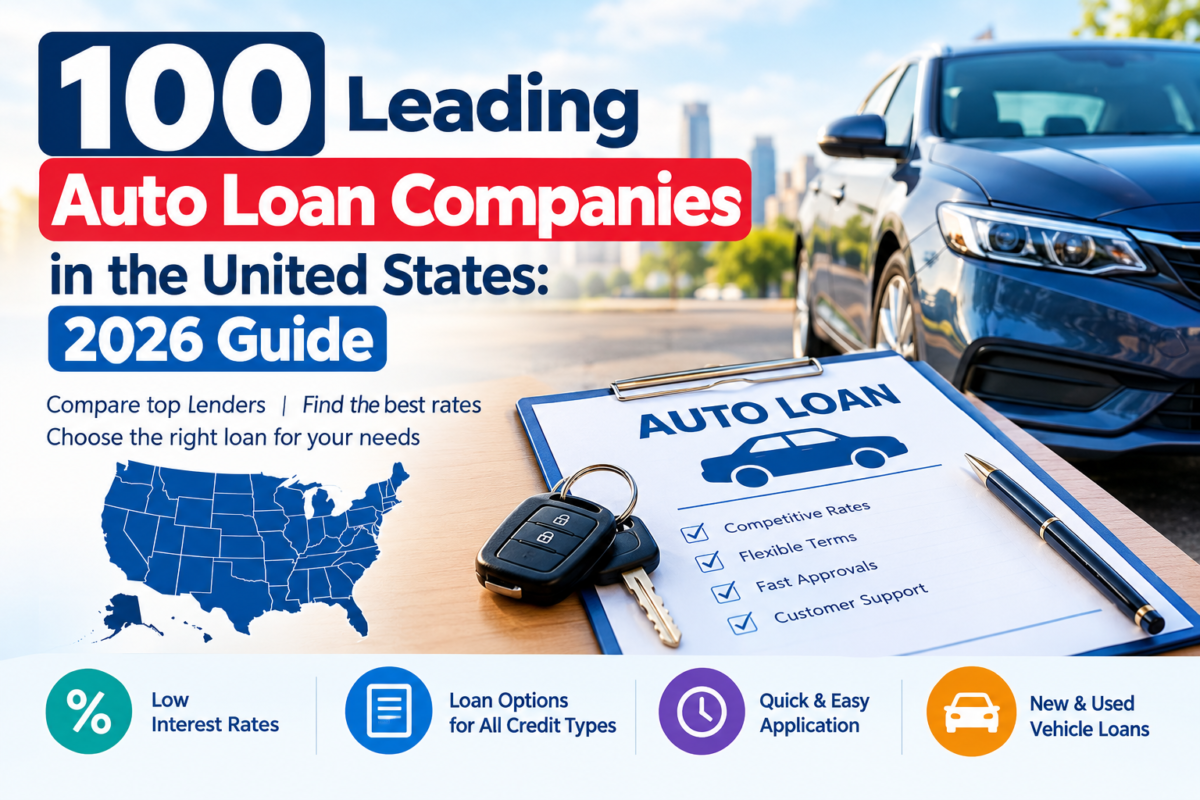
Buying a vehicle is one of the largest financial decisions many Americans make, and choosing the right auto loan can have a significant impact on the total cost of ownership. In 2026, consumers can choose from traditional banks, credit unions, manufacturer-affiliated finance companies, online lenders, dealership financing networks, and specialized auto-finance providers.
According to Experian’s 2026 automotive finance data, banks accounted for 27.15% of total automotive finance market share in Q2 2026, followed by captive finance companies at 26.26% and credit unions at 20.38%. The market continues to evolve as borrowers compare interest rates, loan terms, monthly payments, vehicle eligibility requirements, and refinancing opportunities.
This guide covers 100 notable auto loan companies and financing providers in the United States for 2026. The list is not intended as a numerical ranking because lenders serve different borrower groups and offer different products.
What Is an Auto Loan Company?
An auto loan company provides financing that allows consumers to purchase a new or used vehicle and repay the borrowed amount over an agreed period. Depending on the lender, financing may also be available for refinancing an existing auto loan, buying out a lease, or purchasing certain specialty vehicles.
Auto financing generally involves three major components:
- Principal: The amount borrowed to purchase the vehicle.
- APR: The annual percentage rate representing the cost of borrowing, including applicable fees.
- Loan term: The amount of time available to repay the loan.
Borrowers may obtain financing directly from a bank or credit union or through a dealership. The Consumer Financial Protection Bureau explains that dealer-arranged financing can involve banks, credit unions, and nonbank finance companies, while consumers can also seek preapproval directly from financial institutions.
100 Leading Auto Loan Companies in the United States
The following companies represent a broad cross-section of U.S. auto financing, including banks, credit unions, captive manufacturer lenders, online lenders, and specialized automotive finance providers.
Major Banks and National Auto Lenders
- Bank of America – Offers vehicle financing for eligible new and used vehicles through its banking platform.
- Capital One Auto Finance – Provides vehicle financing and dealer-connected auto financing options.
- Chase Auto – A major auto-finance operation serving consumers through dealerships and other channels.
- Wells Fargo Auto – Provides automotive financing through dealer relationships.
- Ally Auto – A major automotive finance provider offering dealer-based vehicle financing and related services.
- U.S. Bank – Provides auto loans through its consumer banking network.
- PNC Bank – Offers vehicle financing for qualifying borrowers.
- TD Auto Finance – Provides automotive financing through participating dealerships.
- Truist – Offers consumer lending products that include auto financing.
- Fifth Third Bank – Provides auto financing through its banking and dealer network.
- KeyBank – Offers vehicle financing in eligible markets.
- BMO Bank – Provides consumer and vehicle financing products.
- Huntington Bank – Offers auto loans and other consumer lending products.
- Regions Bank – Provides auto financing and consumer banking services.
- Santander Consumer USA – Specializes heavily in automotive financing through dealer relationships.
- Citi – Provides financial services and has participated in vehicle financing through various automotive programs.
- Comerica Bank – Offers consumer financial products, including vehicle financing in applicable markets.
- M&T Bank – Provides auto loans and other consumer lending services.
- Frost Bank – Provides vehicle financing in its service markets.
- First Citizens Bank – Offers consumer and vehicle lending products.
Manufacturer-Affiliated Auto Finance Companies
Manufacturer finance companies are especially important because they can offer financing directly through automobile dealerships. Promotional financing may sometimes be available for specific vehicle models or qualified customers.
- Ford Credit – Financing arm associated with Ford vehicles.
- Toyota Financial Services – Provides financing and leasing for Toyota vehicles.
- Lexus Financial Services – Provides financing and leasing for Lexus vehicles.
- Honda Financial Services – Offers financing and leasing for Honda vehicles.
- Acura Financial Services – Provides financing for Acura vehicles.
- Hyundai Motor Finance – Provides financing and leasing for Hyundai vehicles.
- Genesis Finance – Provides financing and leasing associated with Genesis vehicles.
- Kia Finance – Offers financing and leasing for Kia vehicles.
- Nissan Motor Acceptance Company – Provides financing and leasing for Nissan vehicles.
- Infiniti Financial Services – Provides financing and leasing for Infiniti vehicles.
- Mazda Financial Services – Offers financing programs for Mazda customers.
- Mitsubishi Motors Credit of America – Provides financing for Mitsubishi vehicles.
- Subaru Motors Finance – Offers financing and leasing associated with Subaru.
- Volkswagen Credit – Provides financing and leasing for Volkswagen vehicles.
- Audi Financial Services – Offers financing and leasing for Audi vehicles.
- BMW Financial Services – Provides financing and leasing for BMW customers.
- Mercedes-Benz Financial Services – Offers financing and leasing for Mercedes-Benz vehicles.
- Volvo Car Financial Services – Provides financing and leasing for Volvo vehicles.
- Polestar Financial Services – Provides financing-related services for eligible Polestar customers.
- Jaguar Financial Services – Offers financing and leasing options associated with Jaguar vehicles.
- Land Rover Financial Services – Provides financing and leasing for Land Rover vehicles.
- Porsche Financial Services – Offers financing and leasing programs for Porsche vehicles.
- Maserati Financial Services – Provides financing programs for eligible Maserati customers.
- Chrysler Capital – Provides financing for Chrysler, Dodge, Jeep, and related Stellantis brands.
- Ally Auto Finance – Participates in financing across numerous automotive brands and dealerships.
Captive lenders remain an important component of the automotive market. Experian reported that captive finance companies represented 26.26% of total automotive financing in Q2 2026.
Credit Unions and Member-Based Auto Lenders
Credit unions can be particularly relevant for borrowers looking for competitive financing through a member-based financial institution.
- PenFed Credit Union – Provides auto loans, refinancing, and other consumer financial products.
- Navy Federal Credit Union – Offers auto financing to eligible members.
- Consumers Credit Union – Provides vehicle financing and refinancing.
- Alliant Credit Union – Offers auto loans and other consumer lending products.
- SchoolsFirst Federal Credit Union – Provides auto financing for eligible members.
- America First Credit Union – Offers vehicle loans and refinancing.
- BECU – Provides auto financing and consumer banking services.
- First Tech Federal Credit Union – Offers auto loans and refinancing.
- Digital Federal Credit Union (DCU) – Provides auto financing for eligible members.
- Navy Army Community Credit Union – Offers vehicle financing and related consumer products.
- Redwood Credit Union – Provides auto loans and other consumer lending.
- Golden 1 Credit Union – Offers auto loans and refinancing.
- SchoolsFirst FCU – Provides financing for eligible vehicle purchases.
- America’s First Network Credit Union – Offers consumer and vehicle financing.
- Mountain America Credit Union – Provides auto loans and refinancing.
- First Community Credit Union – Offers vehicle lending in its membership markets.
- Lake Michigan Credit Union – Provides auto financing and other consumer loans.
- Suncoast Credit Union – Offers vehicle loans and refinancing.
- Navy Federal-affiliated lending programs – Provides financing options to eligible military-connected members.
- SECU – Offers vehicle financing to eligible members in its service area.
- State Employees’ Credit Union – Provides consumer lending, including vehicle financing.
- Randolph-Brooks Federal Credit Union (RBFCU) – Offers auto loans and refinancing.
- Baxter Credit Union (BCU) – Provides vehicle financing and consumer loans.
- Consumers Credit Union of Illinois – Offers auto financing and refinancing options.
- Logix Federal Credit Union – Provides auto loans and other consumer lending products.
Credit unions play a particularly significant role in refinancing. Experian reported that credit unions represented 63.43% of automotive refinancing in Q1 2026, compared with 22.59% for banks.
Online Auto Lenders and Automotive Finance Platforms
Online financing providers have made it easier for consumers to compare financing options without visiting multiple physical branches.
- LightStream – Offers unsecured financing that can be used for eligible vehicle purchases.
- myAutoLoan – An online platform that connects borrowers with auto-loan offers.
- Carvana – Provides vehicle financing integrated with its online car-buying platform.
- CarMax Auto Finance – Provides financing connected to CarMax vehicle purchases.
- Autopay – Focuses on auto financing and refinancing services.
- Caribou – Provides an online platform for comparing auto refinancing options.
- LendingTree – Provides a marketplace for comparing financial products, including auto loans.
- RateGenius – Provides auto refinancing services and lender matching.
- RoadLoans – Provides automotive financing options for qualifying consumers.
- OpenRoad Lending – Specializes in automotive financing and refinancing.
- Credit Acceptance – Provides financing solutions primarily through participating dealerships.
- Westlake Financial – Provides automotive financing through dealership networks.
- DriveTime – Offers vehicle financing associated with its used-car retail operations.
- Bridgecrest – Provides auto-finance services associated with vehicle financing portfolios.
- Flagship Credit Acceptance – Provides automotive financing through participating dealers.
- AmeriCredit – Provides automotive finance services through dealer networks.
- Global Lending Services – Provides vehicle financing through participating dealerships.
- Prestige Financial Services – Offers automotive financing services.
- Exeter Finance – Provides vehicle financing through dealer relationships.
- Lendbuzz – Offers technology-driven automotive financing solutions.
Additional Automotive Finance Providers
- Westlake Technology Holdings – Provides technology and financial services connected to automotive lending.
- CPS Financial – Provides automotive financing services.
- Consumer Portfolio Services – Specializes in automobile finance for qualifying borrowers.
- Regional Management Corp. – Provides consumer finance products in selected markets.
- Credit Acceptance Corporation – Works with dealerships to provide financing solutions for vehicle buyers.
- Santander Consumer USA – Provides automotive financing across a broad dealer network.
- Global Lending Services – Offers dealer-based automotive financing.
- Exeter Finance – Provides automotive lending solutions through dealers.
- AmeriCredit Financial Services – Provides vehicle financing through automotive dealerships.
- First Investors Financial Services – Provides automotive finance solutions through participating dealerships.
How to Choose an Auto Loan Company in 2026
Having a large number of lenders to choose from can make the financing process more complicated. Instead of focusing only on the advertised interest rate, borrowers should compare the complete cost and conditions of each offer.
1. Compare APRs
The annual percentage rate is one of the most important figures when comparing auto loans. A lower APR can reduce the amount of interest paid over the life of the loan.
However, advertised rates may only be available to borrowers who meet specific credit, income, vehicle, or term requirements.
2. Consider the Loan Term
Longer loan terms can reduce the monthly payment but may increase the total interest paid.
Experian reported that the average new-vehicle loan term was 69.48 months in Q1 2026, while the average used-vehicle loan term was 67.73 months. More than one-third of new-vehicle loans had terms longer than six years.
Borrowers should therefore compare both the monthly payment and total amount paid.
3. Check Your Credit
Credit history and credit score can influence eligibility and pricing. Before applying, consumers should review their credit reports and correct inaccurate information where appropriate.
A stronger credit profile may give a borrower access to a broader selection of financing offers.
4. Get Preapproved
Preapproval can help establish a realistic vehicle budget before visiting a dealership.
A bank or credit union may provide a proposed loan amount, APR, and repayment term. The borrower can then compare that offer with dealer financing.
The CFPB specifically recommends shopping around because consumers do not have to accept the first financing offer presented by a dealership.
5. Compare New and Used Vehicle Financing
New and used vehicles can have different financing requirements and rates. Some lenders specialize in one market, while others finance both.
Used vehicles may also have restrictions involving age, mileage, or vehicle value.
6. Look at Fees
Potential costs can include origination fees, documentation-related charges, late fees, or other financing expenses. Review the loan agreement carefully before signing.
7. Consider Refinancing
Refinancing may make sense when market rates decline, a borrower’s credit profile improves, or the borrower finds a lender offering more favorable terms.
Experian reported that borrowers who refinanced in Q2 2026 reduced their average interest rate by more than 2.4 percentage points, while average monthly savings reached approximately $83.
Auto Loans for Different Credit Profiles
Not every lender serves every borrower in the same way.
Excellent Credit
Borrowers with strong credit may qualify for competitive rates from banks, credit unions, manufacturer finance companies, and online lenders.
Good Credit
Consumers with good credit should compare several lenders rather than assuming their existing bank has the lowest rate.
Fair Credit
Credit unions, online lenders, and specialized automotive finance companies may provide additional financing possibilities.
Bad or Limited Credit
Some lenders specialize in borrowers with limited or damaged credit histories. However, these loans can carry higher interest rates and may have additional conditions.
The CFPB notes that borrowers with weak credit should still consider checking banks and credit unions rather than assuming dealer-based or buy-here-pay-here financing is the only available option.
Bank vs. Credit Union vs. Dealer Financing
There are important differences between the major financing channels.
Banks: Often provide established online applications, preapproval tools, and broad geographic availability.
Credit unions: Membership-based institutions that may offer competitive auto-loan products to eligible members.
Manufacturer finance companies: Can provide promotional financing or special offers connected to specific vehicle brands.
Dealer financing: Convenient because financing can be arranged during the vehicle purchase, but consumers should compare the dealer’s offer with outside financing.
Online lenders: Allow consumers to research and apply digitally and can make comparison shopping easier.
Consumer Reports notes that captive automaker finance companies can be significant players in the market, while large banks such as Bank of America, Capital One, Chase, and Wells Fargo provide extensive online financing capabilities.
2026 Auto Financing Trends
The U.S. auto finance market continues to change as consumers respond to vehicle prices and borrowing costs.
One major trend is the use of longer loan terms to manage monthly payments. Experian reported that 35.55% of new vehicles financed in Q1 2026 had loan terms exceeding six years.
Another important development is refinancing. As borrowers search for lower payments, refinancing activity has become an increasingly important part of the automotive finance market.
Subprime financing is also significant. Experian reported that subprime borrowers represented 15.75% of total vehicle financing in Q1 2026, up from 14.40% a year earlier.
Consumers are also increasingly considering hybrids and other vehicle types based on monthly affordability. Experian reported that new hybrid vehicles had an average loan payment of $646 in Q2 2026, compared with $692 for EVs and $721 for gasoline-powered vehicles.
Final Thoughts
The U.S. auto loan market in 2026 includes hundreds of banks, credit unions, captive finance companies, online lenders, and specialized automotive finance providers. The 100 companies highlighted in this guide illustrate the variety of financing sources available to American consumers.
There is no single auto lender that is appropriate for every borrower. Loan rates, eligibility requirements, loan amounts, repayment periods, vehicle restrictions, fees, and refinancing options can vary substantially between providers.
The most useful approach is to compare several offers based on APR, total borrowing cost, loan term, monthly payment, fees, vehicle eligibility, and repayment flexibility. Getting preapproved before negotiating with a dealer can also give buyers a useful reference point when evaluating dealer-arranged financing.
In 2026, longer loan terms and affordability remain important issues, while refinancing and credit-union financing continue to play major roles in the market. By researching multiple lenders and reading the complete loan disclosures before signing, consumers can make a more informed auto-financing decision.
Frequently Asked Questions About Auto Loan Companies in the United States
1. What are the leading auto loan companies in the United States in 2026?
The U.S. auto-loan market includes major banks, credit unions, manufacturer-affiliated finance companies, online lenders, and specialized automotive finance providers. Examples include Chase Auto, Capital One Auto Finance, Bank of America, Wells Fargo Auto, Ally Auto, Ford Credit, Toyota Financial Services, Honda Financial Services, PenFed Credit Union, and Navy Federal Credit Union.
2. How do I choose the right auto loan company?
Compare lenders based on APR, loan term, total repayment cost, fees, credit requirements, vehicle eligibility, monthly payment, and refinancing options. Getting quotes from several lenders can help you understand the financing options available to you.
3. What is an auto loan?
An auto loan is financing used to purchase a new or used vehicle. The borrower generally makes scheduled monthly payments that include principal and interest until the loan is paid off.
4. What factors affect an auto loan interest rate?
Auto-loan rates can be affected by factors such as credit history, credit score, income, loan amount, repayment term, vehicle type and age, down payment, and lender requirements. Market conditions can also affect available rates.
5. Should I get preapproved for an auto loan before buying a car?
Preapproval can help you estimate your financing budget and compare an outside financing offer with dealership financing. It can also give you an idea of the potential loan amount, APR, and repayment term before negotiating for a vehicle.
6. Are credit unions good sources for auto loans?
Credit unions are an important source of vehicle financing in the United States. Eligible members can compare credit-union auto loans with bank, manufacturer-finance, and online-lender offers to determine which terms meet their needs.
7. Can I get an auto loan with bad credit?
Some lenders specialize in financing borrowers with poor or limited credit histories. However, eligibility, interest rates, down-payment requirements, and loan terms vary. Borrowers should carefully compare the total cost of financing before accepting an offer.
8. Can I finance a used car with an auto loan?
Yes. Many banks, credit unions, online lenders, and automotive finance companies offer financing for used vehicles. Some lenders have restrictions involving the vehicle’s age, mileage, value, or condition.
9. Can I refinance my existing auto loan?
Yes. Auto-loan refinancing allows a borrower to replace an existing vehicle loan with a new loan, potentially with a different APR, payment, or repayment term. Eligibility and potential savings depend on the borrower’s circumstances and the new lender’s requirements.
10. What is the difference between a bank auto loan and dealer financing?
A bank auto loan is obtained directly from a financial institution, while dealer-arranged financing is facilitated through an automobile dealership. Dealer financing can be convenient, but consumers can also compare it with preapproved offers from banks and credit unions.
11. What is manufacturer financing?
Manufacturer financing is provided through a vehicle manufacturer’s affiliated finance company. Companies such as Toyota Financial Services, Ford Credit, Honda Financial Services, and BMW Financial Services provide financing or leasing programs associated with their respective brands.
12. Does a longer auto loan term reduce my monthly payment?
Generally, extending the loan term can reduce the required monthly payment because the balance is spread over more months. However, a longer term can result in more interest being paid over the life of the loan.
13. How much should I put down on a car?
There is no universal down-payment amount that works for every buyer. A larger down payment generally reduces the amount financed and may reduce the monthly payment. Buyers should consider their budget, cash reserves, vehicle price, and financing terms.
14. Can I get an auto loan without a large down payment?
Some lenders offer financing with relatively small down payments, depending on creditworthiness, vehicle eligibility, income, and other underwriting factors. A smaller down payment may result in a larger loan balance and potentially higher monthly payments.
15. How long are auto loans typically in the United States?
Auto-loan terms vary by lender, vehicle, borrower, and loan amount. Common terms can range from several years to longer periods. Consumers should compare the monthly payment with the total interest and overall repayment amount.
16. What credit score is needed for an auto loan?
There is no single minimum credit score required by every auto lender. Lenders establish their own eligibility standards, and borrowers with different credit profiles may receive different rates and terms.
17. Can applying for multiple auto loans hurt my credit?
Multiple credit applications can affect credit reports depending on how lenders conduct their inquiries. Consumers shopping for auto financing should understand the lender’s application process and how credit inquiries are treated under applicable credit-reporting rules.
18. What fees should I look for in an auto loan?
Depending on the lender and transaction, borrowers may encounter fees related to loan processing, documentation, late payments, title or registration, or other services. Review the loan agreement and disclosures carefully to identify applicable charges.
19. What is APR on an auto loan?
APR, or annual percentage rate, represents the annual cost of borrowing expressed as a percentage. It is useful when comparing financing offers because it incorporates the interest rate and certain applicable finance charges.
20. Are online auto lenders safe to use?
Online auto lenders can be legitimate sources of vehicle financing, but consumers should verify the lender’s identity, licensing or registration where applicable, loan terms, privacy practices, fees, and contact information before submitting an application or personal information.
21. Can I use an auto loan to buy a car from a private seller?
Some banks and credit unions offer private-party auto loans, while others finance only vehicles purchased through dealerships. Borrowers should confirm the lender’s vehicle and seller requirements before entering into a transaction.
22. Can I use an auto loan to buy an electric vehicle?
Many lenders finance electric vehicles and hybrids. However, eligibility requirements can vary based on the vehicle’s age, purchase price, condition, and lender policies.
23. What happens if I miss an auto loan payment?
A missed payment can result in late fees and may eventually affect your credit history. Repeated or serious payment delinquency can create additional consequences, including potential repossession. Borrowers who anticipate difficulty making payments should contact their lender promptly.
24. What is the difference between financing and leasing a vehicle?
Financing generally involves borrowing money to purchase a vehicle and eventually owning it after the loan is repaid. Leasing involves making payments for the right to use a vehicle for a specified period under a lease agreement, subject to its terms and conditions.
25. How can I compare the 100 auto loan companies in this guide?
Compare lenders using consistent criteria, including APR, loan term, estimated monthly payment, total repayment cost, fees, minimum and maximum loan amounts, vehicle restrictions, credit requirements, preapproval availability, and refinancing options. Because lender terms change, verify current terms directly with each provider before applying.
26. Are the 100 companies listed in this guide ranked from best to worst?
No. The list is intended as a directory of notable auto financing providers rather than a ranking. Different lenders serve different borrowers and have different eligibility requirements, products, geographic availability, and financing structures.
27. Can I negotiate my auto loan interest rate?
Depending on the lender and financing arrangement, there may be opportunities to compare or negotiate financing terms. Obtaining competing offers before purchasing a vehicle can give borrowers useful information when evaluating available financing.
28. What should I check before signing an auto loan?
Review the APR, amount financed, finance charge, total of payments, monthly payment, loan term, fees, late-payment provisions, prepayment conditions, collateral requirements, and any other terms in the financing agreement. Make sure the information matches what you agreed to before signing.
29. Can I pay off my auto loan early?
Some auto loans can be paid off early, but borrowers should review their specific contract for any applicable conditions or fees. Paying early can reduce future interest in some circumstances, depending on the loan structure.
30. Why should I compare multiple auto lenders in 2026?
Comparing multiple lenders can help consumers understand differences in APRs, repayment terms, fees, eligibility requirements, and financing options. A single lender may not offer the same terms as another lender for the same borrower and vehicle.
Read More: