

Home Loan Interest Rates: How to Find Today’s Rate and What Affects It
October 26, 2026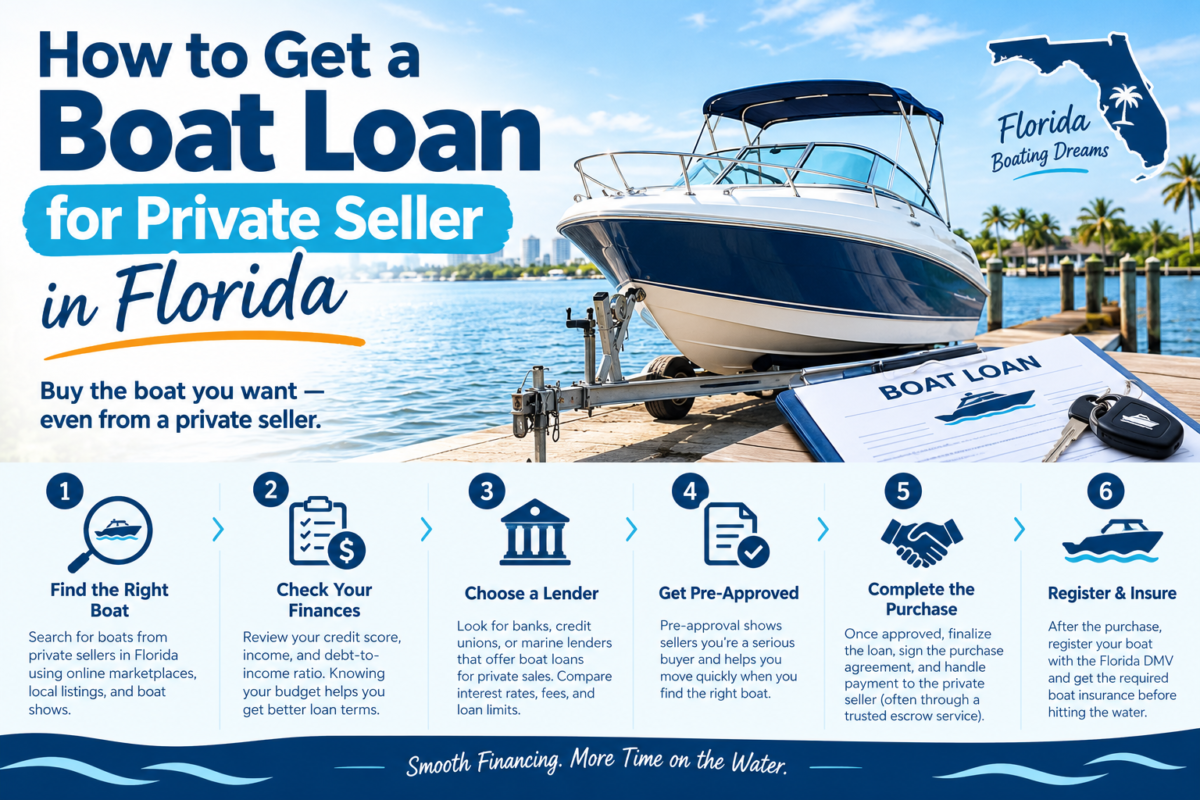
how to get a boat loan for private seller in florida
A private-party boat loan is financing used to purchase a boat directly from an individual owner, rather than through a marina or dealership. The loan is secured by the boat in many cases, and the lender evaluates both the borrower and the vessel before approving the transaction. This type of financing can help buyers who find a suitable used boat through a private listing, but the process may involve additional documentation compared with a dealer purchase.
Dealer-arranged financing is typically coordinated through the dealership, which may submit applications to lending partners and manage sale paperwork. With a private seller, the buyer generally works with a lender independently and must ensure that the purchase agreement, title, registration, and any lien information satisfy the lender’s requirements. Depending on the lender, funds may be sent directly to the seller after closing conditions are met, or the lender may require proof of a properly documented sale before releasing or reimbursing funds. Buyers should ask how payment will be handled before agreeing to a closing date.
A personal loan is another possible way to pay for a boat, but it is usually unsecured and may have different interest rates, loan limits, and repayment periods. Home-equity borrowing uses a borrower’s property as collateral instead, creating risks tied to the home and a separate application process. These options are not equivalent to a boat-specific loan, so compare their costs and obligations carefully.
Eligibility for a private seller boat loan can depend on the boat’s age, type, market value, condition, and intended use, as well as the borrower’s credit and finances. Some lenders set limits on older boats, certain vessel categories, or boats needing substantial repairs. Requirements, down payments, rates, and terms vary. To understand how to get a boat loan for a private seller in Florida, contact lenders early, describe the vessel accurately, and confirm documentation and funding rules before making an offer. This helps avoid committing to a purchase the lender cannot finance.
Before deciding how much to borrow, estimate the complete cost of owning the boat. The advertised price is only a starting point: include your down payment, loan interest, Florida sales tax, and title and registration charges. Also request insurance estimates and account for a marine survey or inspection, which can reveal issues that affect both the purchase decision and financing. If the boat needs repairs, add a realistic allowance rather than assuming it is ready for use. These expenses may be due before or soon after closing, so keep enough cash available instead of directing every dollar toward the down payment.
Ongoing costs matter just as much as the initial transaction. Budget for storage or marina fees, fuel, routine maintenance, and seasonal preparation. Older boats may require more frequent service, while usage, size, and location can change fuel and storage costs. Set aside a separate reserve for unexpected repairs, such as engine or electrical work; a breakdown can be costly and may prevent you from using the boat. Comparing ownership costs across several boats can help you avoid choosing a vessel whose purchase price fits your budget but whose annual expenses do not. Ask insurers and storage providers for written estimates where practical.
Your financing terms also depend on your financial profile. Lenders may consider your credit history, income, existing debt obligations, requested loan term, and down payment when assessing an application. A stronger credit profile or larger down payment may improve the available terms, while a longer term can reduce monthly payments but increase total interest. When learning how to get a boat loan for a private seller in Florida, compare the annual percentage rate (APR), fees, and total repayment—not just the monthly payment. Review any prepayment conditions and make sure the payment remains manageable alongside operating costs. Build flexibility into your budget so an unexpected expense does not strain household finances.
Before arranging payment or applying for financing, confirm that the seller has the legal right to transfer the boat. Ask to see government-issued identification and compare the seller’s name with the name on the title or other ownership records. If the seller is acting for someone else, request documentation showing authority to make the sale. A lender may require clear proof of ownership before funding, so resolving questions early can prevent delays and protect you from paying for a vessel the seller cannot legally convey.
In Florida, check the vessel’s title and registration status with the appropriate state or county office, such as the Florida Department of Highway Safety and Motor Vehicles or a county tax collector’s office. Requirements can depend on the boat’s size and type, its prior registration, and whether it is exempt from titling. Some federally documented vessels, for example, may have different ownership records from state-titled boats. Ask the relevant authority what documents apply to this specific vessel, and confirm that the seller can provide the original title or other acceptable transfer paperwork. Registration alone should not be treated as proof of ownership.
Carefully compare the hull identification number (HIN) stamped on the boat with the number printed on the title, registration, and sale documents. Any mismatch, alteration, or missing number should be investigated before you proceed. Also check for recorded liens and make sure any outstanding loan is paid off and the lien properly released as part of the transaction. If names, dates, or vessel details differ across records, ask the seller to correct the discrepancy through the relevant authority rather than relying on an informal explanation. Missing paperwork, unresolved liens, or uncertainty about title status can complicate a lender’s review and transfer of ownership. When considering how to get a boat loan for a private seller in Florida, make document verification part of the process: agree on how funds and title documents will be exchanged, and do not release payment until the ownership issues are resolved.
When researching how to get a boat loan for a private seller in Florida, begin by identifying lenders that explicitly finance private-party purchases. Banks and credit unions may offer marine loans to existing customers, while specialized marine-finance companies often focus on vessel lending. Some online lenders and boat-loan brokers can also provide options. Confirm that the lender will work directly with an individual seller; financing designed only for dealership purchases may not apply, even if its advertised rates appear attractive.
Compare the conditions attached to each offer, not just the interest rate. Ask about minimum and maximum loan amounts, required down payments, available repayment terms, and whether the rate is fixed or variable. Find out about application, documentation, origination, and title-related fees, as well as any prepayment charges. Vessel eligibility can differ substantially: lenders may set limits on boat age, condition, value, or survey requirements. Ask whether a particular hull material, engine type, or propulsion system affects eligibility, and whether older or higher-mileage boats can be financed.
Clarify the transaction process before choosing a lender. Ask how funds are paid to the seller, what documents are needed to verify ownership, and how the title transfer and lien recording are handled. In Florida, confirm which party coordinates each step and whether the lender requires the title to be clear of existing liens before closing. For an older vessel, ask whether an inspection, marine survey, or engine evaluation is required and who pays for it. Request written estimates from several lenders using the same purchase price, down payment, and loan term. A preliminary advertised rate may depend on credit, vessel age, or other conditions, so it is not a reliable basis for comparison by itself. Review the quoted annual percentage rate, total interest, estimated payment, and fees together. Comparing complete written offers can help you understand the true cost, identify restrictions early, and select financing that fits both the boat and the private-sale process.
Before making a firm offer on a boat, seek prequalification from one or more lenders. This can help you estimate the loan amount, interest rate, and monthly payment you may qualify for, making it easier to set a realistic budget and compare financing options. When researching how to get a boat loan for a private seller in Florida, contact lenders that finance private-party purchases and ask about their application process, minimum loan amounts, eligible boats, and any age or condition restrictions. Prequalification is an early estimate, not a promise of financing. Final approval may depend on a full credit review, verification of your finances, and an appraisal or inspection of the boat.
Prepare basic information before applying. Lenders commonly request your legal name and other identity details, current residence, employment history, and income. You may also need to report monthly debts, the amount you want to borrow, and how much you can provide as a down payment. Have available information about the boat, including its make, model, year, asking price, identification number, and the seller’s details. A lender may require a bill of sale or other purchase documentation later, but these details can help it assess whether the proposed transaction meets its requirements. Giving complete, consistent information can reduce delays and help lenders provide a more useful preliminary estimate.
Expect the lender to review your credit and potentially request documents that substantiate your application. These may include recent pay statements, tax records, bank statements, or proof of insurance, depending on your circumstances and the lender’s policies. Ask in advance whether prequalification involves a soft credit inquiry, which generally does not affect your credit score, or a hard inquiry, which may be recorded on your credit file. Also ask when a credit check will occur and whether multiple applications could affect your score. While your application is under review, avoid opening new credit accounts, financing another purchase, or taking on additional debt. A change in your finances can alter your debt-to-income profile and affect final approval or loan terms.
Before making a private-party boat purchase final, arrange an independent marine survey or inspection by a qualified professional. A seller’s description and maintenance records can be useful, but they do not replace an objective assessment of the vessel’s condition. Depending on the boat’s age, type, and propulsion system, you may also want a separate engine evaluation by a marine mechanic. These checks can reveal issues that affect safety, future repair costs, insurability, and the boat’s value. Include the expected cost and scheduling time for inspections when planning how to get a boat loan for a private seller in Florida.
Ask the surveyor to examine the hull and structural components, electrical and plumbing systems, onboard equipment, and safety gear, as well as the engine and other relevant mechanical systems. A survey may also provide an estimated market value. Give the lender a copy of the report if requested: some financing programs require a marine survey, appraisal, or particular insurance coverage before issuing final approval. Contact the lender and insurer early to confirm their standards, since requirements can vary with the boat’s age, size, value, and condition. Address any deficiencies or coverage conditions before relying on a loan approval or setting a closing date.
The lender’s valuation may differ from the price you and the seller negotiated. If the appraised value is lower, the lender may calculate its maximum loan using that lower figure, leaving you to provide a larger down payment, negotiate a reduced price, or reconsider the purchase. Do not assume financing will cover the full agreed amount until the lender confirms its valuation and terms. Where practical, make the written purchase agreement contingent on a satisfactory inspection, final financing approval, and confirmation that the seller can provide clear title. State deadlines and deposit terms clearly, and consider professional advice when drafting the agreement. These safeguards help you identify problems before becoming financially committed and support a more informed decision about the boat.
Before money changes hands, put the purchase terms in a written bill of sale signed by both parties. Identify the boat by make, model, year, hull identification number, and any outboard motor or trailer included in the deal. State the agreed price, deposit amount, items included, expected closing and delivery dates, and any conditions required by the lender. The document should also explain how an existing loan or lien will be paid off. Clear terms help the buyer, seller, and lender coordinate the transaction and reduce disputes about what was promised.
Send the lender the requested documents promptly, which may include the signed purchase agreement, registration, title, and lien payoff information. If the boat has an outstanding lien, ask the lender and lienholder how it will be satisfied and how the lien release and title will be handled. Do not assume the seller can transfer clear ownership simply by signing a bill of sale. Buyers learning how to get a boat loan for a private seller in Florida should confirm the lender’s required sequence in writing, including which documents must be approved before funds are released.
Follow the lender’s payment instructions rather than arranging an informal cash handoff. Depending on its process, the lender may use escrow, pay the seller directly, or approve another documented arrangement. Confirm who receives the funds, what evidence is required, and when the title transfer and delivery should occur. Before taking possession, verify that payment has cleared according to the lender’s guidance, obtain the signed title and lien-release documents where applicable, and record the date and condition of delivery. Make a written inventory of included equipment—such as safety gear, electronics, keys, and trailer components—and have both parties acknowledge it. Keep copies of the bill of sale, loan and payment records, title documents, lien paperwork, and delivery inventory. Organized records can help resolve later questions about ownership, payment, or the boat’s included items.
Once the sale is complete, promptly transfer the vessel’s title and arrange any required registration. In Florida, a buyer generally must apply for a title within 30 days of purchase to avoid a late fee, and registration requirements and timing may also apply. The precise steps can vary depending on the vessel’s type, age, current documentation, and whether it is exempt from titling or registration. Do not assume that a bill of sale alone completes the transfer.
Gather the documents needed to support the application, which may include the properly assigned title, a signed bill of sale, identification, and information showing the purchase price and any applicable sales tax paid or due. If the boat is financed, coordinate with the lender before submitting paperwork. The lender may require its lien to be recorded on the Florida title, and the title application may need to identify the lender and include lien documentation. Confirm that the lien is shown correctly and ask how the lender will handle the title after the loan is paid off.
Before taking possession or operating the boat, obtain insurance that meets the loan agreement’s requirements. A lender commonly requires physical-damage coverage and may specify coverage limits, deductibles, or how it must be listed on the policy. Florida does not require insurance for every recreational vessel, but a lender, marina, or other contract may impose its own conditions. Ask the insurer to confirm that coverage begins on the appropriate date and applies to the vessel and intended use.
Because fees, deadlines, forms, and procedures can change—and may depend on the boat and transaction—verify current requirements with the Florida Department of Highway Safety and Motor Vehicles or the relevant county tax collector before filing. For buyers researching how to finance a private-party boat purchase in Florida, coordinating the title application, lien recording, registration, and insurance with the lender can help prevent avoidable delays after closing.
When considering how to get a boat loan for a private seller in Florida, avoid sending a deposit before confirming that the seller owns the boat and has authority to sell it. Compare the seller’s identification with the name on the title, and verify the vessel’s identifying details against its records. Do not rely on verbal promises about condition, ownership, equipment, or a lien-free title. Check for outstanding liens and ask the lender or appropriate Florida agency what documentation is needed to resolve them before closing. A lien can delay transfer or create unexpected costs for the buyer.
Arrange an independent inspection before committing, even if the boat appears well maintained. A prequalification is not final loan approval: the lender may still need to review the boat, title, purchase contract, and other documents. Read the financing terms, including the interest rate, fees, down payment, and total amount repaid, rather than judging affordability by the monthly payment alone. Use traceable payment methods, such as a lender-approved wire or cashier’s check, and keep receipts. Verify the payment recipient before sending funds. Retain copies of the signed purchase contract, title and registration records, inspection report, and lender documents. Never sign blank or incomplete forms, and make sure every agreed term is written into the contract.
After the purchase, follow the payment schedule and contact the lender promptly if a payment may be late or your financial circumstances change; early communication can clarify available options. Ask whether the loan includes a fee or other restriction for early payoff, and confirm how extra payments are applied to principal. Include routine maintenance, storage, insurance, fuel, and repairs in your ownership budget so that boat expenses do not interfere with loan payments. Requirements and loan terms can change, and details may vary by lender, vessel, or location. Confirm current financing conditions directly with your lender, and check title, registration, and transfer requirements with the relevant Florida state or county authorities before completing the sale.
