
How to get a boat loan for private seller in Florida: A Step-by-Step Guide
October 27, 2026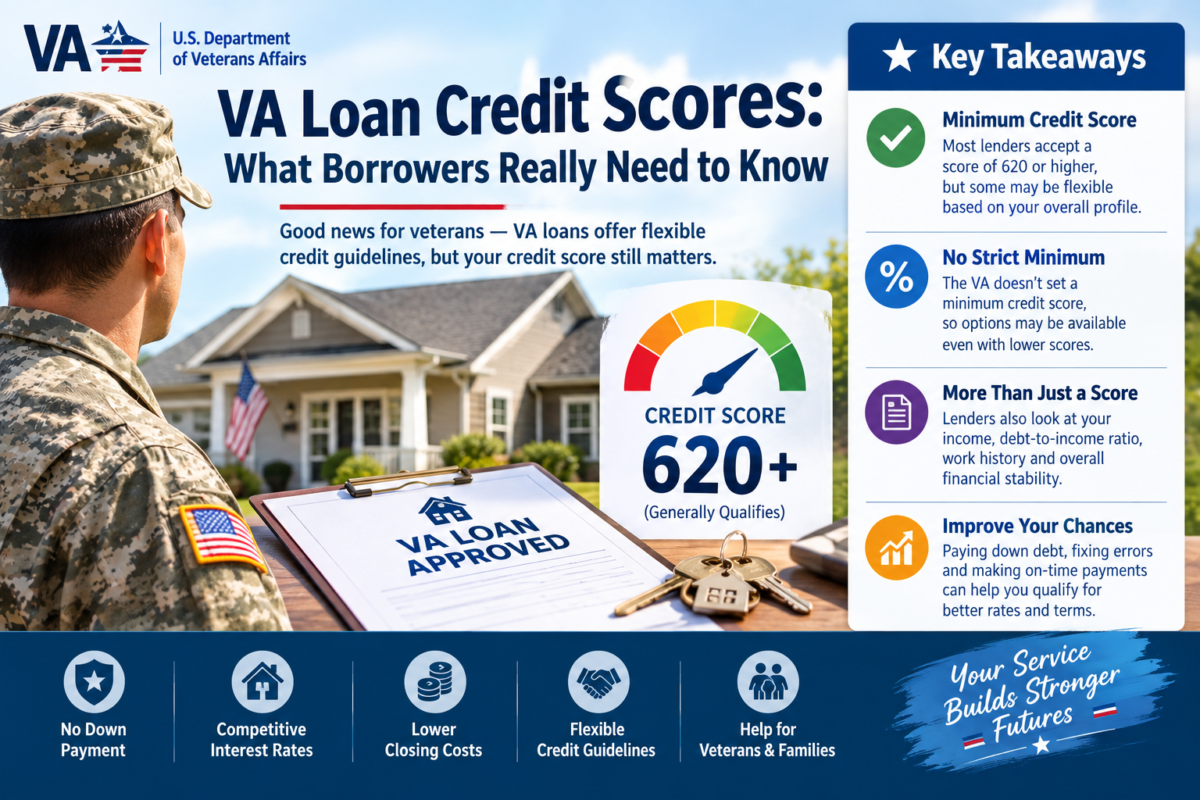
The Department of Veterans Affairs does not set a universal minimum credit score for borrowers seeking a VA-backed home loan. So, when people ask, “what is the minimum credit score for a va loan,” the direct answer is that the VA itself has not established a required score that every applicant must meet. This differs from some mortgage programs that publish a specific score threshold as part of their baseline eligibility rules. A borrower’s credit profile still matters, but there is no single VA-mandated number that automatically determines approval.
The VA’s role is primarily to guarantee a portion of an eligible loan made by a private lender. That guaranty can reduce a lender’s potential loss if a borrower does not repay, and it helps make the program available to qualifying veterans, service members, and other eligible borrowers. The VA does not generally lend money directly to each homebuyer, nor does it review and approve every borrower’s mortgage application. Instead, applicants work with participating banks, credit unions, mortgage companies, or other approved lenders, which assess the application and decide whether to offer financing.
Those lenders set their own credit standards and may use minimum scores as part of their underwriting policies. Their requirements can vary, and a lender’s stated threshold is not the same as a rule imposed by the VA. Some lenders may consider applicants with lower scores, while others may require a higher score or apply stricter standards based on the overall file. As a result, a borrower who does not meet one lender’s criteria may still want to compare options with other VA lenders.
No VA-mandated minimum does not mean that every applicant qualifies regardless of credit. Lenders typically review payment history, current debts, income, assets, and other factors alongside credit scores to evaluate the likelihood of repayment. A stronger credit profile may improve the chances of approval and may affect the terms offered, though each application is assessed individually. Borrowers should ask lenders directly about their current score requirements and how they evaluate the complete application, rather than treating any one advertised number as a universal VA standard.
Although the Department of Veterans Affairs does not set a minimum credit score for VA loans, lenders still assess whether an applicant is likely to repay a mortgage. Credit scores help them evaluate payment history and overall credit management, alongside factors such as income, existing debts, savings, and recent financial setbacks. A VA guarantee reduces some of the lender’s risk, but it does not remove the need to make a careful lending decision. As a result, borrowers may encounter credit requirements even when the VA itself has not prescribed a specific score threshold.
Some mortgage companies commonly look for scores around 620, while others may consider applicants with lower scores or use a different cutoff. These lender-specific requirements are often called overlays: standards added by a lender on top of the VA’s guidelines. An overlay may reflect a company’s underwriting policies, its appetite for risk, or requirements imposed by investors that purchase or service its loans. Therefore, the answer to “what is the minimum credit score for a VA loan” depends in practice on the lender reviewing the application, rather than on a universal VA-mandated number.
Thresholds can also vary with the type of VA loan, market conditions, and changes in a lender’s policies. A score that does not meet one company’s standard may still be acceptable to another. In addition, lenders generally consider the full financial profile, not just a credit score. Stable income, manageable debt, and a record of on-time payments may strengthen an application, while other concerns can matter even when a score meets a stated minimum. Borrowers who are unsure about eligibility can ask lenders directly about their current requirements and compare options with more than one VA-approved lender.
A credit score is an important part of a VA loan application, but it is not the sole measure of eligibility. Borrowers often ask, “what is the minimum credit score for a VA loan?” The VA does not set a universal minimum score for its home loan benefit. Instead, individual lenders assess whether an applicant meets their requirements and can repay the mortgage. A score can help a lender gauge credit risk, but it does not tell the full story of a borrower’s finances or circumstances.
Underwriting may include a review of payment history, including whether bills and existing loans have been paid on time. Lenders may also consider recent late payments, unpaid collections, and the circumstances surrounding bankruptcies or foreclosures. The timing of past credit difficulties and steps taken since then can matter. Income stability is another consideration: underwriters generally assess the amount and reliability of income available to support monthly housing costs, alongside current debts and other financial obligations.
Assets, such as savings or funds available for closing, may also inform the review, as can the requested loan amount and the resulting payment. These factors are considered together rather than as a simple checklist in which one favorable item guarantees success. A stronger overall application may help offset a less-than-ideal credit score, particularly when other evidence indicates responsible financial management and sufficient capacity to repay. However, a high score cannot guarantee approval, and a lower score does not by itself establish that a borrower will be declined. Lender standards and individual circumstances vary, so applicants should ask prospective lenders how they evaluate the complete application and whether additional documentation could clarify their financial picture.
Residual income is the amount of money a borrower is expected to have left each month after paying major obligations and housing costs. In a VA loan review, lenders consider whether this remaining income can reasonably cover everyday needs such as food, transportation, clothing, and utilities. The calculation generally accounts for the proposed mortgage payment, taxes, insurance, other debts, and certain household expenses. It offers a view of repayment capacity that a debt-to-income ratio alone may not provide.
The debt-to-income ratio compares monthly debt payments with gross monthly income, while residual income focuses on the funds left after key expenses. VA underwriting considers both measures, along with factors such as income stability, credit history, and the borrower’s overall financial circumstances. A higher debt ratio may sometimes be offset by strong residual income or other positive indicators, but that does not guarantee approval. Lenders assess the full application and may apply their own standards when evaluating risk.
Residual-income expectations vary according to household size and geographic region. A household with more dependents is generally expected to retain more money each month, while regional guidelines reflect differences in living costs. The applicable VA tables set benchmarks based on these factors and, in some cases, loan size. Borrowers can ask a lender to explain which benchmark applies and how the lender calculated their available monthly income. Reviewing the figures early can help identify budget constraints before an application moves forward.
Passing residual-income and debt-to-income reviews does not automatically remove a lender’s credit-score requirements. The VA does not establish one universal minimum credit score for every borrower, but individual lenders may set minimums or use credit standards that affect eligibility and loan terms. So, when asking what is the minimum credit score for a VA loan, borrowers should distinguish VA guidelines from a lender’s policies. A strong residual-income calculation can support an application, yet it does not necessarily override a lender’s credit criteria. Comparing lenders may help clarify available options.
A lower credit score does not automatically rule out a VA loan. The VA does not set a single minimum credit score for borrowers, but individual lenders generally establish their own credit requirements. So, when asking what is the minimum credit score for a VA loan, it is important to distinguish VA guidelines from a lender’s standards. Some lenders may consider applicants below their usual score threshold, while others may decline an application or require a stronger overall profile. A low score is therefore not a guarantee of rejection, but neither does VA eligibility assure loan approval.
Applicants with lower scores may have more options when other parts of their finances help demonstrate an ability to manage a mortgage. Lenders may consider documented, stable income, manageable monthly obligations, and a history of reliable recent payments. Sufficient residual income—the money remaining after major obligations and housing costs—is also relevant to VA underwriting. These factors can help provide context for a credit history, particularly when a score reflects older difficulties rather than continuing payment problems. However, lenders evaluate the full application, and compensating factors cannot ensure that a particular loan will be approved.
Borrowers should consider contacting multiple VA-approved lenders rather than relying on one initial response. Lenders can apply different credit overlays, or requirements beyond the VA’s baseline rules, and may assess compensating factors differently. Ask each lender about its current score guidelines, how it reviews recent payment behavior, and whether it can evaluate the application before a formal loan decision. A lender may request additional documentation, such as income records, explanations of past credit events, or evidence of available funds. Depending on the complete application, lenders may also offer different loan terms, so compare the costs and conditions as well as eligibility. Before applying, reviewing credit reports for errors and preparing clear records of income and obligations can make discussions more productive. Ultimately, whether a borrower with a lower score qualifies depends on the lender’s policies, underwriting review, and the details of the borrower’s financial circumstances.
Before applying for a VA home loan, review your credit reports from all three nationwide credit bureaus. Look for incorrect late payments, accounts that do not belong to you, duplicate debts, or balances reported inaccurately. Errors can affect a lender’s assessment, so dispute inaccurate information with the bureau and, when appropriate, the company that supplied it. Keep copies of your dispute submissions and supporting documents, and allow time for investigations to be completed. Checking your reports early gives you a chance to address problems before a mortgage application is under review.
Build consistent habits while you prepare. Pay every bill by its due date, including accounts that may not appear on your credit reports. If you use revolving credit cards, reducing their balances can lower the share of available credit you are using. Avoid opening several new accounts in a short period, since applications can lead to hard inquiries and new obligations. Also be cautious about large purchases or other new debt before closing; financing a vehicle or carrying a substantial new balance may change your financial profile and complicate loan approval.
Do not rely solely on a score shown by a free consumer app to predict the score a mortgage lender will see. Lenders may use a mortgage-specific scoring model, and its results can differ from consumer scores. If you are asking, “what is the minimum credit score for a va loan,” remember that VA guidelines do not set one universal minimum, while individual lenders may have their own standards. Ask a prospective lender which scoring model and credit requirements it uses, and review your reports before applying so you can discuss any concerns with context.
Before paying off or closing an account, making a large transfer, or otherwise changing your finances, ask your lender or a qualified housing counselor how the step could affect your application. Some changes have unexpected effects on credit history, utilization, or cash available for closing. A measured plan, based on your full credit picture and the lender’s guidance, is generally more useful than last-minute moves intended to raise a score quickly.
VA loan preapproval gives borrowers an early indication of how much they may be able to finance, but it is not a final approval. A lender typically reviews your credit history and score, verifies income and employment, and makes a preliminary assessment of debts and assets. You may be asked for recent pay stubs, W-2 forms or tax returns, bank statements, and permission to obtain a credit report. This initial review can help identify documentation gaps or credit issues before you make an offer on a home. It can also clarify how the lender approaches the question, “what is the minimum credit score for a VA loan?” The VA does not set a universal minimum score, so lenders may apply different standards.
Consider contacting several VA-approved lenders rather than assuming that one denial means you cannot qualify. A lender’s decision may reflect its own credit requirements, risk policies, or interpretation of your financial profile—not a single rule that applies across the market. When comparing options, ask each lender about its minimum score policy and how it evaluates past credit events, such as late payments, collections, bankruptcy, or foreclosure. Ask whether it offers manual underwriting and whether it considers compensating factors, including substantial savings, a stable employment history, or a low debt-to-income ratio. These details can matter when an application falls outside an automated approval path.
Compare the full cost and service, not just the stated score threshold. Request information about lender fees, the interest rate, discount points, and any conditions attached to a quoted rate. Ask how long the preapproval remains valid and what could cause the estimate to change. A preapproval is a preliminary assessment based on the information available at that stage; it is not a guarantee that the loan will close. During full underwriting, the lender verifies documents, reviews the property and appraisal, and reassesses eligibility. Changes in income, debts, credit, assets, or property details may affect approval or terms. Keeping finances steady and responding promptly to document requests can help the process proceed smoothly.
Several misconceptions can make it difficult to understand what is the minimum credit score for a VA loan. First, eligibility for VA benefits does not guarantee mortgage approval. A Certificate of Eligibility confirms that a borrower may use the VA home loan benefit, but it does not establish that the borrower meets a lender’s credit, income, or financial requirements. Lenders still assess whether an applicant can repay the loan and whether the property and transaction meet applicable standards.
Second, the Department of Veterans Affairs does not set one official minimum credit score that applies to every VA loan. Instead, individual lenders establish their own underwriting policies, often including a credit-score threshold. Some lenders may advertise a relatively low minimum, but that figure is not a promise of approval for every applicant who meets it. A lender may consider other details, such as payment history, outstanding debts, income stability, available funds, and the circumstances behind past credit problems. The same score can therefore lead to different outcomes with different lenders.
Credit scores are only one part of the approval process, and lender policies can change over time. A published requirement may be outdated, may apply only to certain loan situations, or may describe a basic screening threshold rather than the full set of conditions for approval. Borrowers should contact lenders directly to confirm current requirements and ask how their overall financial profile will be reviewed. Comparing more than one lender can also help clarify available options, since guidelines and approaches to evaluating credit vary. General information about VA loan credit requirements is not personalized financial, legal, or lending advice. For a decision based on individual circumstances, consult a qualified lender or financial professional and request an explanation of the relevant requirements before applying.
Start by confirming that you meet the VA’s service-related eligibility requirements. If you do not already have a Certificate of Eligibility (COE), request one through the VA, ask a VA-approved lender to help obtain it, or use the VA’s online system. The COE documents eligibility for the benefit; it does not guarantee loan approval. Next, review your credit reports from all three major bureaus. Check for errors, unfamiliar accounts, late payments, or outdated information, and dispute inaccuracies promptly. Knowing what is on your reports can help you address issues before a lender evaluates your application.
Then estimate your monthly financial obligations. Include minimum payments on credit cards and other debts, expected housing costs, property taxes, homeowners insurance, and any applicable association fees. Compare these expenses with your reliable monthly income to understand how a mortgage payment may fit your budget. Gather recent pay stubs, tax returns or other income documentation, employment history, bank statements, and records of assets or savings. Lenders may request additional documents, so keeping organized copies can make the process smoother. Be prepared to explain significant gaps in employment, unusual deposits, or other details that could prompt follow-up questions.
Contact more than one VA-approved lender before choosing where to apply. Ask each lender directly what credit score policies it uses, whether it considers applications below its preferred score range, and what steps might strengthen a lower-score application. Compare rates, fees, and loan terms as well as eligibility requirements; lender standards can differ. While your application is being reviewed, avoid opening new credit accounts, financing a vehicle, or making large purchases on credit. New debt can change your financial profile and complicate underwriting. Ultimately, what is the minimum credit score for a VA loan depends on how the question is framed: the VA itself sets no minimum score, but individual lenders may apply their own standards. Approval also depends on the complete financial picture, including income, debt, credit history, and the lender’s assessment of repayment ability.