
Calculating a Florida Mortgage loan Payment: A Practical Step-by-Step Guide
October 24, 2026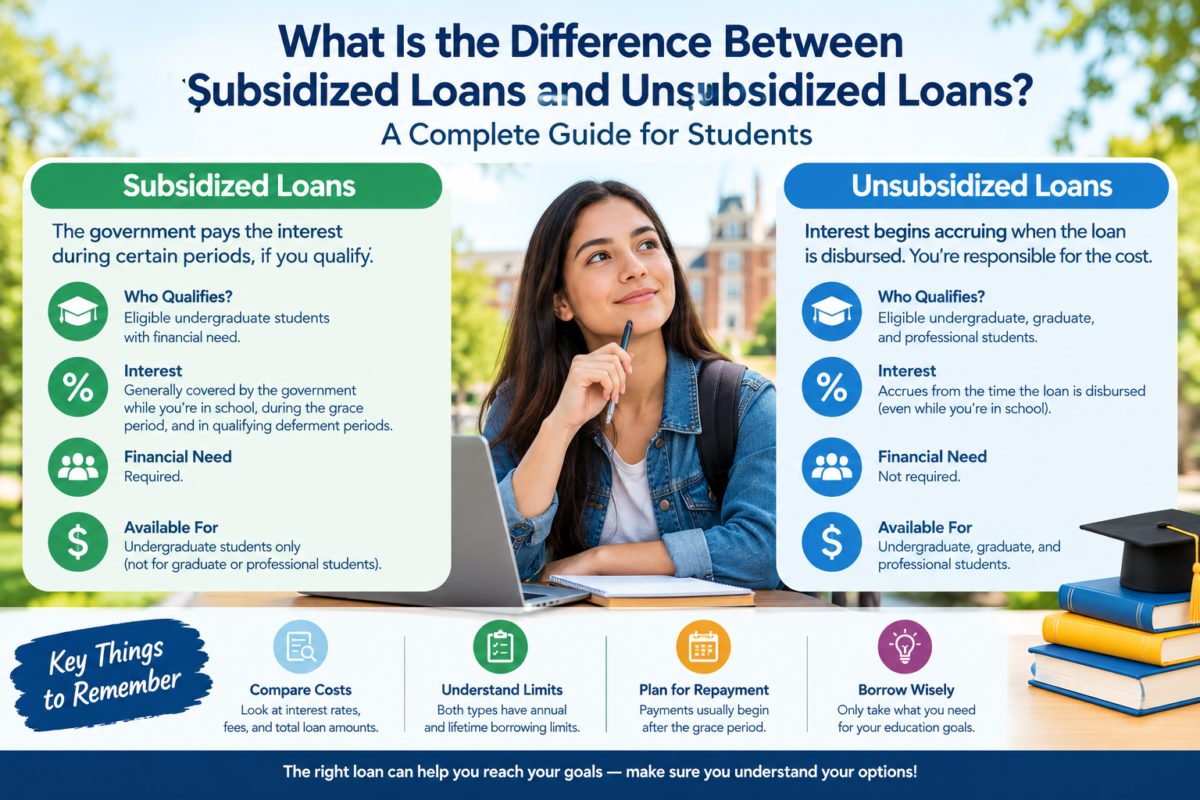
Understanding the difference between subsidized loans and unsubsidized loans is essential for students and families planning to pay for college in the United States. Both are federal student loans designed to help eligible students cover education expenses, but they differ in how interest works, who qualifies, and how much borrowing may cost over time.
The biggest difference is that the U.S. Department of Education generally pays the interest on Direct Subsidized Loans during eligible periods, while borrowers are responsible for interest on Direct Unsubsidized Loans from the time the loan is disbursed. This difference can significantly affect the total cost of a college education.
If you are comparing financial aid offers, applying for federal student aid, or trying to decide which loan to accept, this guide explains how each option works, their eligibility requirements, interest costs, repayment rules, and the factors to consider before borrowing.
What Is a Subsidized Student Loan?
A subsidized student loan, officially called a Direct Subsidized Loan, is a federal student loan available to eligible undergraduate students who demonstrate financial need.
The main benefit is that the federal government generally covers the interest during certain qualifying periods. This means eligible borrowers can avoid accumulating interest while they attend school at least half-time, during the applicable six-month grace period, and during qualifying deferment periods.
For example, suppose you borrow $5,000 through a Direct Subsidized Loan. If you remain eligible and your loan is covered by the subsidy during your time in school, interest generally will not accumulate on that loan during that period.
This feature makes subsidized loans particularly attractive for students who qualify because it can reduce the overall cost of borrowing.
Key features of subsidized loans
- Available to eligible undergraduate students.
- Require demonstrated financial need.
- Have fixed interest rates established for the applicable loan disbursement year.
- Generally receive an interest subsidy during eligible in-school, grace, and deferment periods.
- Have annual and aggregate borrowing limits.
- Require repayment under the applicable federal student loan terms.
Subsidized loans are not available to every student. Eligibility depends on factors such as financial need, enrollment status, the school’s cost of attendance, and other financial aid received.
What Is an Unsubsidized Student Loan?
A Direct Unsubsidized Loan is another type of federal student loan available to eligible undergraduate, graduate, and professional students.
Unlike subsidized loans, Direct Unsubsidized Loans do not require students to demonstrate financial need. Eligibility is based on applicable federal student aid requirements and the school’s determination of how much the student may borrow.
The main disadvantage is that interest begins accruing when the loan is disbursed. The borrower is responsible for that interest, including while enrolled in school and during the grace period.
Students do not usually have to make payments while enrolled at least half-time, but interest can continue accumulating. If unpaid interest is capitalized under applicable loan terms, it can increase the principal balance on which future interest is calculated.
Key features of unsubsidized loans
- Available to eligible undergraduate, graduate, and professional students.
- Do not require demonstrated financial need.
- Accrue interest from disbursement.
- Offer fixed interest rates based on the applicable loan year.
- Allow interest payments while the student is in school, although immediate payment is generally not required.
- Have annual and aggregate borrowing limits.
Unsubsidized loans may be useful for students whose financial aid packages do not cover all eligible education expenses, particularly graduate students who cannot receive Direct Subsidized Loans.
Subsidized vs. Unsubsidized Loans: Key Differences
The following comparison summarizes the main differences between these two federal student loan options.
| Feature | Direct Subsidized Loan | Direct Unsubsidized Loan |
|---|---|---|
| Who qualifies? | Eligible undergraduate students with financial need | Eligible undergraduate, graduate, and professional students |
| Financial need required? | Yes | No |
| Interest while in school | Generally covered by the government during eligible periods | Accrues from disbursement |
| Interest during the six-month grace period | Generally covered | Continues to accrue |
| Interest during eligible deferment | Generally covered | Generally accrues |
| Borrowing limits | Subject to annual and aggregate limits | Subject to annual and aggregate limits |
| Repayment | Generally begins after the grace period | Generally begins after the grace period |
| Best potential advantage | Lower interest costs during eligible periods | Broader eligibility |
These differences are based on the federal Direct Loan program. Your actual eligibility, loan amount, and repayment terms depend on the rules applicable to your loan and academic program.
How Does Interest Work on Subsidized and Unsubsidized Loans?
Interest is one of the most important factors when comparing student loans. Even when two loans have the same initial balance and interest rate, the total cost can differ because of when interest begins accumulating and who is responsible for paying it.
Interest on subsidized loans
For eligible Direct Subsidized Loans, the government generally covers interest while you are enrolled at least half-time, during the applicable six-month grace period after leaving school or dropping below half-time enrollment, and during qualifying deferment periods.
Once the applicable subsidy ends, interest may begin accruing according to the loan terms.
Interest on unsubsidized loans
With a Direct Unsubsidized Loan, interest starts accruing when the funds are disbursed. You are responsible for that interest even if you are still attending college.
You can generally choose to pay the interest while studying or allow it to accumulate. If you leave it unpaid, it may be capitalized when permitted under the applicable rules. Capitalization increases the principal balance, potentially causing additional interest to accrue.
Example: How much interest could an unsubsidized loan accumulate?
Suppose you borrow $10,000 at a hypothetical fixed annual interest rate of 6.5% and make no interest payments for one year.
Original loan amount
$10,000
Illustrative annual interest
$650
Balance before any capitalization
$10,650
Illustration only. Assumes a constant balance and a simple annual calculation; actual federal loan interest accrues daily, and fees or payments can change the result.
If an eligible subsidized loan had the same principal and rate, the borrower generally would not be responsible for interest during a period covered by the subsidy. That can create meaningful savings over several years of college.
Who Is Eligible for Subsidized and Unsubsidized Loans?
Eligibility depends on your student status, financial need, enrollment, and other federal student aid requirements.
Eligibility for subsidized loans
To qualify for a Direct Subsidized Loan, you generally must:
- Be an eligible undergraduate student.
- Demonstrate financial need based on the federal student aid process.
- Attend an eligible school at least half-time.
- Meet applicable citizenship or eligible noncitizen requirements.
- Satisfy federal student aid eligibility requirements.
- Have remaining eligibility under the applicable loan limits.
Graduate and professional students generally cannot receive new Direct Subsidized Loans.
Eligibility for unsubsidized loans
Direct Unsubsidized Loans are available to eligible undergraduate, graduate, and professional students. Demonstrated financial need is not required, but you must satisfy the relevant federal student aid requirements and remain within applicable borrowing limits.
For both loan types, submitting the Free Application for Federal Student Aid (FAFSA) is an important step. Your school uses the information to determine your eligibility and prepare your financial aid offer.
How Much Can You Borrow?
Federal student loan limits vary based on factors such as your year in school, dependency status, academic program, and applicable federal rules.
Under the traditional undergraduate Direct Loan limits, dependent students generally have lower annual borrowing limits than independent students. Subsidized loans also have separate maximum amounts within the combined borrowing limits.
For example, the traditional limits shown by Federal Student Aid include the following undergraduate amounts:
| Year in school | Dependent student: total annual limit | Maximum subsidized portion |
|---|---|---|
| First year | $5,500 | $3,500 |
| Second year | $6,500 | $4,500 |
| Third year and beyond | $7,500 | $5,500 |
These figures reflect the traditional limits published in Federal Student Aid materials. Federal student loan rules and limits changed for some borrowers beginning July 1, 2026, so these figures should not be assumed to apply to every new loan in the 2026–27 academic year. Check the official federal loan limits guidance and ask your school’s financial aid office which limits apply to you.
Remember that qualifying for a maximum loan amount does not mean you should borrow the full amount. Calculate your actual education expenses and look for grants, scholarships, savings, and other funding before deciding how much debt to take on.
Which Loan Should You Accept First?
For students who qualify for both types of federal student loans, a practical approach is to consider the subsidized loan first because its interest subsidy can reduce borrowing costs.
A sensible funding order is:
- Grants and scholarships: These generally do not require repayment, subject to their conditions.
- Work-study and personal resources: Consider available employment income and savings without compromising essential expenses.
- Direct Subsidized Loans: If eligible, consider these before unsubsidized loans because of their interest benefits.
- Direct Unsubsidized Loans: Use these if you still have a genuine funding gap.
- Other borrowing options: Compare alternatives carefully before considering private student loans.
This is a general decision-making framework, not a requirement to follow a specific order. Review your school’s financial aid offer and consider your future repayment ability. Federal Student Aid also recommends understanding all available aid before accepting loans.
Advantages and Disadvantages of Each Loan Type
Both federal student loans can help you pay for higher education, but each has benefits and drawbacks.
Pros and cons of subsidized loans
Advantages
- The government generally covers interest during eligible in-school, grace, and deferment periods.
- They can reduce the overall cost of borrowing.
- They provide access to federal student loan repayment options.
- They may be particularly helpful for students with limited financial resources.
Disadvantages
- Only eligible undergraduate students with demonstrated financial need can qualify.
- Borrowing is subject to annual and aggregate limits.
- The amount offered may not cover all college expenses.
- Interest may begin accruing when the loan is no longer covered by an applicable subsidy.
Pros and cons of unsubsidized loans
Advantages
- Available to eligible undergraduate, graduate, and professional students.
- Financial need is not required.
- Can help cover eligible education expenses when other financial aid is insufficient.
- Offer federal loan benefits, subject to applicable program rules.
Disadvantages
- Interest accrues from disbursement.
- Unpaid interest can increase the amount owed if it is capitalized.
- Borrowing more than necessary can create a substantial repayment burden.
- Annual and aggregate borrowing limits still apply.
The right choice depends on which loans you qualify for, how much money you need, and whether you can manage the future repayment costs.
When Do You Start Repaying These Loans?
Both Direct Subsidized Loans and Direct Unsubsidized Loans generally have a six-month grace period after you graduate, leave school, or drop below half-time enrollment. During this period, you usually do not have to make regular payments.
However, the interest treatment differs:
- Subsidized loans: The government generally covers interest during the applicable grace period.
- Unsubsidized loans: Interest continues to accrue during the grace period.
After the grace period, repayment begins under the applicable loan terms unless a different rule, deferment, forbearance, or repayment arrangement applies.
Federal repayment rules can change, and available plans depend on the borrower’s circumstances and the loan’s eligibility. Visit Federal Student Aid for current repayment information.
Can You Pay Interest on an Unsubsidized Loan While in College?
Yes. You can generally make voluntary interest payments while you are enrolled in school, even when regular payments are not required.
Paying interest early can help prevent it from accumulating. Depending on the loan terms and applicable rules, this may also reduce the chance that unpaid interest will later be added to your principal balance.
For example, if you borrow $10,000 and accrue $650 in interest during a year, paying that interest as it accumulates can help keep the principal balance at $10,000 rather than allowing the debt to grow.
You do not necessarily have to pay every dollar of interest immediately if your budget cannot support it. Prioritize essential living and education expenses, and speak with your school’s financial aid office or loan servicer if you need help understanding your options.
How Do You Apply for Subsidized or Unsubsidized Student Loans?
The application process generally begins with federal student aid.
- Complete the FAFSA. Submit the Free Application for Federal Student Aid through the official FAFSA website. Provide accurate information and meet the applicable deadlines.
- Review your financial aid offer. Your school will explain the types and amounts of aid for which you qualify, including any subsidized or unsubsidized loans.
- Compare your options. Review grants, scholarships, work-study, and loans. Consider your actual funding gap instead of automatically accepting the maximum loan amount.
- Accept only what you need. Follow your school’s instructions to accept, reduce, or decline the offered loans.
- Complete required loan documents. First-time borrowers may need to complete entrance counseling and sign a Master Promissory Note, as applicable.
- Track disbursements and interest. Check your student account and loan records so you understand how much was borrowed and when interest begins accumulating.
The financial aid office at your college can explain your eligibility, deadlines, and the loan terms that apply to your situation.
Common Mistakes to Avoid When Choosing Student Loans
Students can make borrowing decisions that become expensive over time. Avoid these common mistakes:
- Accepting every loan offered: An award offer is not a requirement to borrow the full amount.
- Ignoring interest: Unsubsidized loan interest can accumulate during school, so consider its long-term impact.
- Confusing loans with grants: Loans generally must be repaid, while grants typically do not, subject to applicable conditions.
- Overlooking borrowing limits: Confirm which annual and lifetime limits apply to your academic year and borrower category.
- Assuming all federal loans are identical: Different federal loan programs have different eligibility, interest, and repayment terms.
- Failing to plan for repayment: Consider your expected earnings, likely monthly expenses, and the amount of debt you will have after graduation.
Careful planning can help you obtain the funds needed for school without taking on more debt than necessary.
Frequently Asked Questions (FAQs)
1. What is the main difference between subsidized and unsubsidized loans?
The main difference is who pays the interest during eligible periods. The government generally covers interest on Direct Subsidized Loans during qualifying in-school, grace, and deferment periods. Borrowers are responsible for interest on Direct Unsubsidized Loans from disbursement.
2. Are subsidized loans better than unsubsidized loans?
Subsidized loans are generally less expensive during periods covered by the interest subsidy. If you qualify for both, compare your aid offer and consider accepting the subsidized loan first before borrowing additional funds through an unsubsidized loan.
3. Do unsubsidized loans require financial need?
No. Direct Unsubsidized Loans do not require demonstrated financial need. However, students must meet applicable federal student aid eligibility requirements.
4. Can graduate students get subsidized loans?
Generally, no. New Direct Subsidized Loans are available to eligible undergraduate students. Graduate and professional students may qualify for Direct Unsubsidized Loans, subject to applicable limits and program rules.
5. Do both loans have to be repaid?
Yes. Both are federal student loans that must generally be repaid with applicable interest. The interest subsidy on a subsidized loan does not eliminate the borrower’s obligation to repay the principal.
6. Does interest accrue on subsidized loans while I am in school?
Generally, no, provided you are enrolled at least half-time and the loan qualifies for the applicable interest subsidy. Different rules may apply once the subsidy period ends.
7. Can I pay off an unsubsidized loan early?
Yes. Federal student loans generally allow early repayment without a prepayment penalty. Paying extra toward your loan can reduce the amount of interest you pay over time, depending on how the payment is applied.
8. What happens if I cannot afford my student loan payments?
Contact your loan servicer promptly and review the repayment options available to you. Depending on your circumstances and the rules applicable to your loans, you may qualify for an alternative repayment arrangement, deferment, or forbearance. Do not ignore missed payments, as delinquency and default can have serious consequences.
9. Where can I check my federal student loan balance?
Sign in to your account at StudentAid.gov to review your federal student loan information. You can also contact your loan servicer for details about your balance, interest, and repayment status.
10. Should I accept subsidized and unsubsidized loans together?
You may be able to accept both if your school offers them and you meet the eligibility requirements. Consider using the subsidized loan first and borrowing only the additional unsubsidized amount needed to cover your remaining eligible education expenses.
Conclusion: Which Student Loan Is Right for You?
The difference between subsidized loans and unsubsidized loans comes down primarily to interest costs and eligibility. Direct Subsidized Loans provide an interest benefit for eligible undergraduate students with financial need, while Direct Unsubsidized Loans offer broader eligibility but require borrowers to pay interest from disbursement.
If you qualify for a subsidized loan, it is generally worth considering before an unsubsidized loan. However, the best borrowing decision also depends on your total education costs, other financial aid, available savings, and future ability to repay the debt.
Before accepting either loan, review your financial aid offer, confirm the rules applicable to your academic year, and borrow only what you reasonably need. For official information, use Federal Student Aid and consult your school’s financial aid office.